
Shelby City Directory Collections
Shelby has a documented run of Miller's directories, plus telephone books and related local-history material in the Eugenia H. Young Memorial Library North Carolina Room. The confirmed bibliography names 1937/38, 1945/46 through 1957/58, 1961/62, and 1963/64. A separate 1943/44 Miller's Shelby volume fills a gap in that cited list. These Shelby city directory sources help establish an address, occupation, or household clue for a particular printing year. They do not establish a continuous annual series, and an unlisted year should never be read as proof that a person was absent from town.
| Collection | Years | Where held | Access |
|---|---|---|---|
| Miller's Shelby N.C. City Directory | 1937/38; 1943/44; 1945/46–1957/58; 1961/62; 1963/64 | North Carolina Room; 1943/44 at DigitalNC | Onsite volumes and free catalog/PDF route |
| Telephone books | Exact shelf years not published | North Carolina Room | Ask staff about volume and format |
| Shelby Star microfilm | 1902–present, newest issues delayed about three months | North Carolina Room | Onsite microfilm and copy rules |
| School annuals and family files | Exact inventory not published | North Carolina Room | Onsite handling and finding aids |
The library also keeps deeds, wills, births, voter records, tax lists, cemetery surveys, census material, historic maps, and local publications. That breadth matters when a directory entry needs a second source. The collection pages confirm access to printed volumes and phone books, but do not publish a complete shelf list or a confirmed reverse-directory run. Request the relevant years and ask whether a volume is alphabetical, reverse, criss-cross, or telephone-only.
Shelby Directory at DigitalNC
The digitized route is the 1943/44 Miller's Shelby N.C. City Directory, published by Southern Directory Company. It is a page-image publication rather than a searchable database with separate name and address fields. Search the catalog for the volume, then read the printed page carefully and preserve its page number with every note. A browser may have trouble opening the direct PDF, so the catalog page and the library are practical alternatives when a page image will not load.
The DigitalNC catalog record for the 1943/44 Shelby directory identifies the digitized volume and its catalog route.
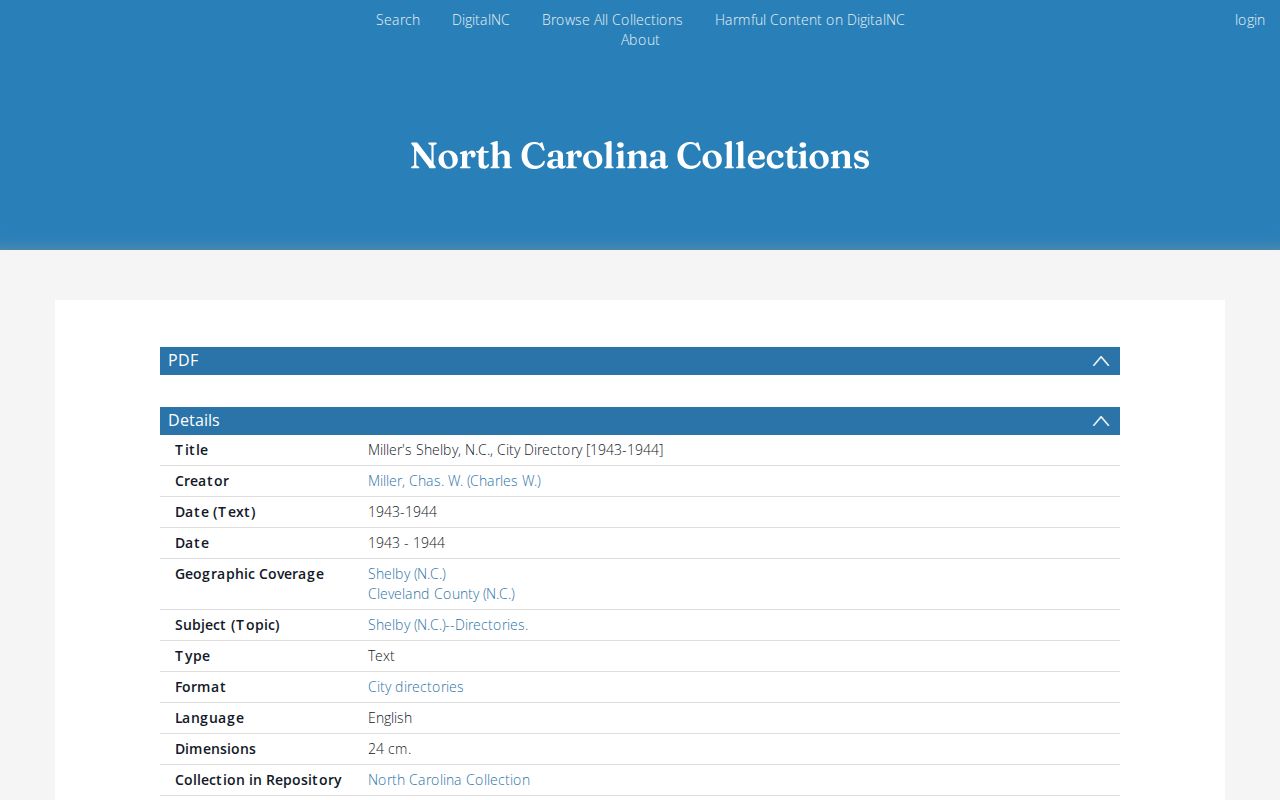
Use the catalog as a citation point, then record the printed page and section so another reader can check the same Shelby printed entry.
Directory dates reflect compilation and printing. They are useful date markers, but not a precise move-in or move-out day. A person may be listed under initials, with a spouse notation, at a business address, or in a classified section. Compare spelling variants before deciding that two entries belong to different people. Note: A missing directory year is a gap in the available record, not evidence that a household left Shelby.
Shelby Directory Research Desk
The North Carolina Room at the Eugenia H. Young Memorial Library is the key local desk for a Shelby directory trail. It lists walk-in hours on Monday, Tuesday, Wednesday, Thursday, and Friday, with shorter time windows that should be checked before a visit. Appointments with North Carolina Collection Librarian Kallen Terry require 24 hours' notice and are not guaranteed. The library also offers an out-of-area research-request form, while warning that staff cannot perform extensive genealogy on a requester's behalf.
The library's genealogy and local-history page describes the North Carolina Room, its local sources, and its research-request route.
The room connects directories with newspapers, maps, yearbooks, cemetery surveys, and family files, which is useful for a former classmate, relative, or family-history question that has a name and an approximate year.
Materials do not circulate. The room has a microfilm reader queue of about 30-minute slots, allows non-flash photography, and asks visitors to follow handling rules such as no food or drink. The first ten black-and-white copies per day are free; additional black-and-white copies cost $0.15 per page. The library describes one address as Howie Drive while another county history page says Howie Street, so verify the street suffix before mailing material.
Reading a Shelby Directory Entry
A Shelby printed entry is a bundle of clues, not a modern identity profile. The 1943/44 volume can contain a surname and given name, spouse or household notation where printed, occupation or business affiliation, street address, telephone detail where included, and abbreviations for a widow, boarder, or similar status. Some volumes may contain tenure or dwelling notation. Read the front matter and abbreviation key before interpreting a short mark. The research did not permit a page-level transcription of an individual resident, so no sample name or field order should be assumed.
| Name | Surname and given name or initials, which may need comparison with spelling variants. |
|---|---|
| Household notation | Spouse, relationship, widow, or boarder notation where the printed volume uses it. |
| Occupation | Work or business affiliation as printed, useful for separating people with the same name. |
| Address | Street address or business location, a historical clue rather than a current-status claim. |
| Placement | Page number and alphabetical or classified section, with a cross-reference if the volume contains one. |
- Criss-cross directory
- A directory arranged by address or street rather than only by surname. Confirm that the requested Shelby volume has this section before relying on it.
- Householder index
- An index centered on a household head or address. It may omit boarders, relatives, and other people who were not indexed under that heading.
- Abbreviation key
- The printed explanation of short labels used in an entry. Photograph or transcribe it before assigning meaning to a notation.
Shelby Directories and Census Dates
Use directories to bridge the years between federal census snapshots. Begin with a surname or approximate street, then compare the known Shelby volumes in sequence. Keep the exact address, initials, spouse notation, occupation, and phone clue in a dated worksheet. The federal census is available for 1850, 1860, 1870, 1880, and 1900 through 1950 under the 72-year rule. The general 1890 loss creates a real break, so tax lists, deeds, newspapers, and local enumerations can be more useful around that decade.
- Find the surname or approximate address in the 1943/44 scan or the library's Shelby volumes, and note the page and section.
- Check the documented 1937/38, 1945/46–1957/58, 1961/62, and 1963/64 runs without treating an unavailable year as an absence.
- Compare the entry's spelling, initials, household clue, occupation, and street number across available years.
- Pair the directory date with the nearest census year and a deed recording date, keeping occupant and title evidence separate.
- Use an obituary or probate file to close a family trail, then confirm the underlying record with its custodian.
Local history adds an unusual preservation lead. P. Cleveland Gardner reportedly rediscovered copies of the 1850 and 1870 Cleveland County census material in a courthouse basement in 1937. Gardner-Webb is identified as a repository for 1850 county census material. That story explains why an old family trail may have a local route, but a specific census page still needs its own repository citation.
Shelby Directory Maps and News
When a street number does not make sense, use a historical map before forcing it into a current address. The Cleveland County Archive lists Shelby Sanborn material from 1885 through 1921. The Library of Congress catalog identifies an April 1926 Shelby set of 22 sheets. Sanborn sheets can show a building footprint, adjoining street, alley, lot context, and land use. They do not name every occupant, so pair the map with a directory page, a deed plat, and current county mapping.
The Cleveland County Archive media browser provides the archive route for local Sanborn material and historical newspaper excerpts.
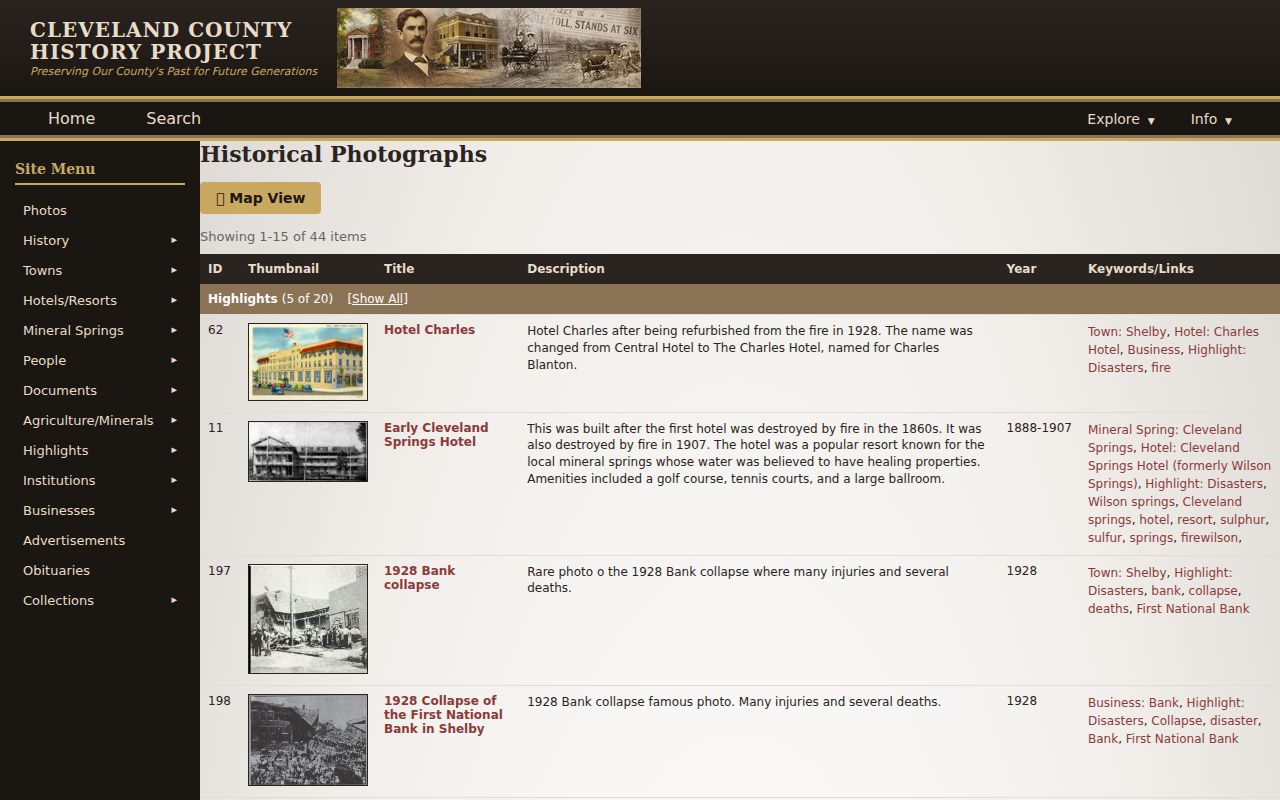
The archive is a historical collection, not a citywide directory search, so item metadata and the archive contact route should accompany each map or newspaper citation.
The Shelby Star microfilm begins in 1902 and reaches the present with an approximate three-month delay for the newest issues. Obituaries, marriage announcements, legal notices, civic events, and address mentions can test whether a directory clue fits a household. Older newspaper titles in the State Archives guide offer another route where the Shelby Star does not cover the needed period.
Tracing Families in Shelby Directories
Family-history work is strongest when it labels each record for what it proves. A directory can place a printed name, address, household notation, or occupation at the time of compilation. A deed identifies a title transfer, not every person in the home. A census captures a household at its enumeration date. An obituary may name relatives and former addresses. Keeping those roles separate avoids turning a historic address into a present-day assertion.
Start the local trail with one name, one street or parcel, one approximate year, and one focused question. The North Carolina Room can direct a visitor to a directory, microfilm reel, cemetery survey, newspaper, or family file. The Cleveland WebGIS property search can supply a modern parcel reference when the question turns to a current parcel, while the historical volumes remain the better source for an earlier household. Note: A directory occupant, a deed holder, and a current parcel owner can be different people.
Shelby Directory Custodian Trail
Shelby is both an incorporated city and the Cleveland County seat, so related records sit with different custodians. The library holds local print, microfilm, and finding aids. The Register of Deeds keeps recorded land instruments. The Clerk of Superior Court holds official court and estate files. The State Archives describes older county series, including miscellaneous records from 1833 and 1841–1938. Match the request to the source rather than expecting a library directory to certify a deed or a county index to replace an archival box.
For current address-keyed records, the fuller parcel and deed sequence belongs with the Shelby Street Directory. For a historical name that needs a contemporary check, compare independently dated records and ask the appropriate office for an official copy. That division keeps a Shelby printed directory useful for historical context without overstating what a volume can establish.